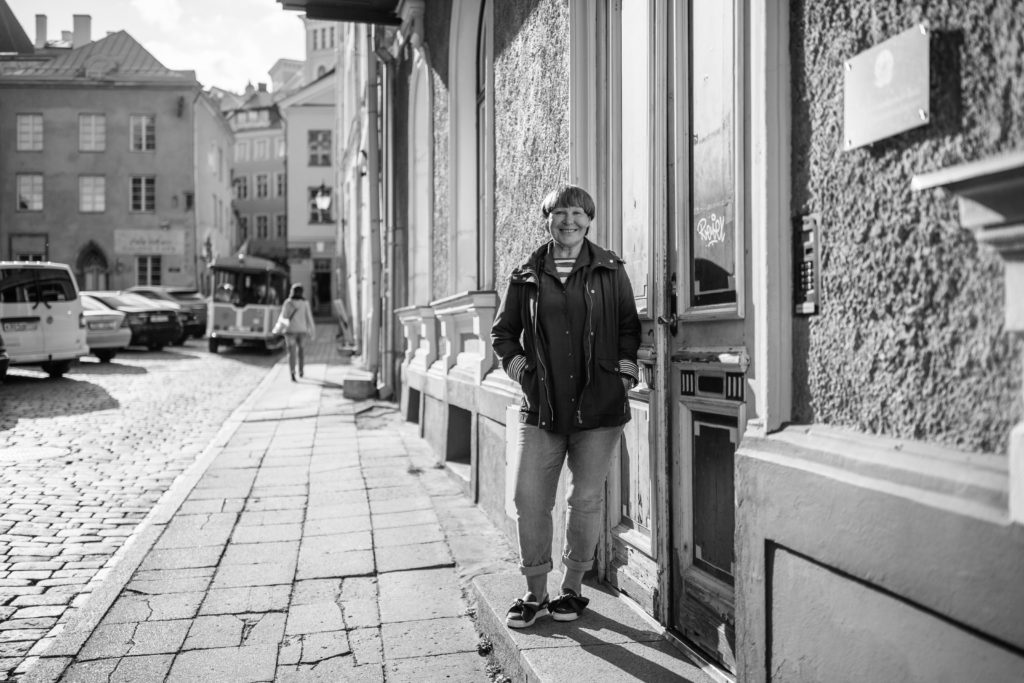
VIIVI LUIK
Born in 6th November 1946
Arne Merilai
University of Tartu
BOOKS
Poetry: Pilvede püha: luuletusi aastatest 1961–1963 (Tallinn: Eesti Raamat, 1965);
Taevaste tuul: teine luulevihik (Tallinn: Eesti Raamat, 1966);
Lauludemüüja (Tallinn: Eesti Raamat, 1968);
Hääl (Tallinn: Perioodika, 1968);
Ole kus oled (Tallinn: Eesti Raamat, 1971);
Pildi sisse minek (Tallinn: Eesti Raamat, 1973);
Põliskevad (Tallinn: Eesti Raamat, 1975);
Luulet 1962-1974 (Tallinn: Eesti Raamat, 1977);
Maapäälsed asjad (Tallinn: Eesti Raamat, 1978);
Rängast rõõmust (Tallinn: Eesti Raamat, 1982); also in Swedish (1994);
Maa taevas ([Tallinn:] 1998);
Elujoon: valitud luuletused 1962-1997 ([Tallinn:] Tänapäev, 2005).
Fiction: Salamaja piir (Tallinn: Perioodika, 1974) (Loomingu Raamatukogu 34, 1974);
Seitsmes rahukevad: romaan (Tallinn: Eesti Raamat, 1985); translated into English by Madli Puhvel as The Seventh Spring of Peace (forthcoming; an extract in Orient Express, 3 (2003): 30–53); also published in Finnish (1986), Norweigian (1987), Swedish (1988), Russian (1988), Ukrainian (1989), German (1991), French (1992), Spanish (1993), Latvian (1995); staged in Tübingen, Germany (1994);
Ajaloo ilu (Tallinn: Eesti Raamat, 1991); translated into English by Hildy Hawkins as The Beauty of History (forthcoming); also published in Finnish (1991), Russian (1992), Dutch (1993), Swedish (1993), Danish (1994), Norweigian (1994), Latvian (1995), German (1995), Islandic (1998), Hungarian (2000), French (2001), Catalan (2005).
Drama: “Koera sünnipäev,” in Kas kuulete...?: valimik raadionäidendeid aastatest 1994–2000, compiled by T. Tohver ([Tallinn:] Eesti Raadio Raadioteater ja Kirjastuskeskus, [2002]: 105–124); released by Eesti Raadio (1994, director Aare Toikka), by WDR, Germany (1995), Yeisradio, Finland (1995), and Swedish Radio (1995);
“Pilli hääl: ooperi libreto”, Looming, 1 (January 2000): 59–71.
Essays: Inimese kapike ([Tallinn:] Vagabund, 1998); also published in Russian (Raduga 2, 3, 4 (1999)), partly in German (1992, 2003) and Dutch (1999): 72–73;
Seitse naist (Scarborough, Ontario: Maarjamaa, 1988).
Children’s literature: Poetry: Tubased lapsed (Tallinn: Eesti Raamat, 1979); also in Russian (1985);
Kolmed tähed (Tallinn: Eesti Raamat, 1987);
Fiction: Leopold (Tallinn: Eesti Raamat, 1974); also in Russian (1978);
Vaatame, mis Leopold veel räägib (Tallinn: Eesti Raamat, 1974);
Leopold aitab linnameest (Tallinn: Eesti Raamat, 1976);
Kõik lood Leopoldist (Tallinn: Eesti Raamat, 1984);
Textbook: Meie aabits ja lugemik (Tallinn: Koolibri, 1992).
OTHER
Translations of poems: Books: Bolshie derevja: stihi iz semi knig, translated into Russian by Nora Javorskaja (Tallinn: Eesti Raamat, 1978);
Ruka tshelovetsheskaja: stihi, translated into Russian by Svetlan Semenenko (Moskva: Sovjetskij pisatelj, 1984);
On aastasaja lõpp. Das Jahrhundert ist zu Ende, translated into German by Gisbert Jänicke (Tallinn: Eesti Raamat, 1993);
Single poems: Poeti Estoni, edited by (Roma: Edizioni Abete, 1973, 1975) (in Italian, translated by Margherita Guidacci and Vello Salo);
Osud motyla: antologia mladej estonskej poezie, compiled by V. Macura (Bratislava: Smena 1984) (in Czech, by Vladimir Macura);
Trajekt 5 (1985) (in German, by Ilmar Laaban);
Das Leben ist noch neu: zehn estnische Autoren: eine Anthologie, edited by K. E. R. Lindemann (Karlsruhe: Edition Junge Poesie, 1992) (in German, by Gisbert Jänicke);
Tallinn,compiled by S. Schmidt (Klagenfurt/Celovec: Wieser, 2003) (in German, by Gisbert Jänicke);
Estonia, 3 (1999) (in German, by Gisbert Jänicke);
Die Freiheit der Kartoffelkeime: Poesie aus Estland: Jaan Kaplinski, Doris Kareva, Hasso Krull, Viivi Luik, Ene Mihkelson, Paul-Eerik Rummo, compiled by G. Laschen (Bremerhaven: edition die horen, 1999) (in German, by Marcel Beyer, Johann P. Tamman, Friedrich Christian Delius, Gregor Laschen, and Ralf Thenior);
Woorden in de wind van de Oostzee: estische poëzie uit de twintigste eeuw, compiled by C. Hasselblatt and M. Vogel (Leuven: Uitgeverij P. 2005) (in Dutch, by Marianne Vogel, Theo van Lint, and Cornelius Hasselblatt);
Song lyrics on CD-s: Gunnar Graps: Tühjad pihud (Tallinn: Elwood-Muusik, 1995);
Heidy Tamme: Kristalne vaikus (Tallinn: SE & JS Meedia, 1995);
Eesti kuld II (OK Records, 1997);
Tiit Kikas: Hetked (BGM Records, 1997);
Ellerhein: Kasvasin kesk kadakaid (Tallinn: Forte, 1998);
Ruja: Need ei vaata tagasi... I (HyperElwood, 1999);
Significatio: Eesti kammermuusikat / Estonian Chamber Music (Tallinn: Eesti Raadio, 1999);
Urmas Alender: Kogutud teosed I, 1968-1980 (Yoko Alender: hyper.elwood, 2000);
Veljo Tormis: Tähemõrsja / Star bride (TÜ Akadeemiline Naiskoor, 2000);
Id Rev: Sina ei ([Tallinn:] Assortii, 2001);
Tajo Kadjas: Vihmade taga / Behind the Rain (Tallinn: edition 49, 2001);
Rein Rannap: Varajased laulud (hyper.records, 2002);
Kait Tamra: Kõigel on kõigega seos. All Are One With the Rest (Tallinn: ARM Music, 2002);
Urmas Alender: Kohtumine Albertiga (Alender-Leht, 2003);
Tajo Kadajas: 10 Years After: Compilation 1991–2001 (Estonian Authors Society, 2003)
Riho Sibul: Jahe sinine (Tallinn: Vagabund, 2003);
Joel Friedrich Steinfeldt: 50 parimat laulu (Tallinn: Hitivabrik, 2003);
Olav Ehala: Armastatud laulud (Tallinn: Mojo Records, 2004);
Hedvig Hanson: Nii õrn on öö (MT Holding, 2004);
Tajo Kadajas et al: Hingelaulud / Songs of the soul (Tajo Kadajas, 2004);
Hendrik Relve: Laulud looduses (Tallinn: ARM Music, 2004);
Kalle Sepp: Kesktalve kevad (Tallinn: Vinge Records, 2004);
Joel Friedrich Steinfeldt: Teiste laulud minu suul (Tallinn: TopTen, 2005);
Hedvig Hanson: You Bring Me Joy (Emarcy, USA: Universal, 2005);
Marju Kuut: Raagus sõnad (Bigtree, 2005);
Klassikaraadio – 10: Eesti klassika, folk ja džäss / Estonian Classical, Folk and Jazz Favourites (Tallinn: Eesti Raadio, 2005);
VIIVI LUIK is one of the most treasured poets and prose writers of contemporary Estonian literature; she is also a children’s writer, essayist and dramatist. With her poetry she addresses the reader of her own mother-tongue from the depth of their history, language and culture, whereas her novel Seitsmes rahukevad (Seventh Spring of Peace) was published in a number of foreign languages, in countries such as in Finland, Sweden, Norway, Switzerland, Austria and Germany. The other novel, Ajaloo ilu (Beauty of History), has also been translated into various languages and acclaimed as a bestseller.
Viivi Luik was born on 6 November in 1946 in Tänassilma, Viljandimaa county near Lake Võrtsjärv. Her father was a travelling electrician who was often away, her mother worked at the local collective farm. The only child without friends of her own age was mostly brought up by her mother and grandmother. The girl was independent and imaginative, struggled to read already at the age of three and henceforth read everything available at home, in neighbouring farms, school or village library (Victor Hugo’s Les Miserables, Romain Rolland’s Jean-Christophe, Estonian poets Gustav Suits, Marie Under, Ernst Enno…). At the same time she tried to write something herself and, as any bright child, felt a bit bored at the elementary and basic schools at Risti (1954–59), Kalmetu (1959–63) and Viljandi (1962). From 1965 to 1967 the budding poet studied at the Tallinn extramural secondary school, working at the same time as a librarian and an archivist.
Viivi Luik’s first poem appeared in the local Viljandi district daily in 1962. Next year she wins the first award at the literary competition organised by magazine Pioneer for schoolchildren, although some editors of the magazine visited her beforehand, to make sure that the poems had not been sent by an adult. In 1964 she debuted in the literary magazine Looming (Creation). The first collection of poetry, Pilvede püha (Holiday of Clouds), was published in 1965. Since that time ten more collections have appeared, three books of selected verse, as well as fiction, numerous essays, children’s books and two plays. In 1967 Viivi Luik became a freelance writer and joined the Estonian Writers’ Union in 1970. Collections of poetry Põliskevad (Perpetual Spring, 1975) and Rängast rõõmust (Of Hard Joy, 1982), as well as the Leopold stories for children (1974–76) and the novel Seventh Spring of Peace (1985) received the Juhan Smuul annual literary award in 1976, 1977, 1983 and 1986. In 1986 the collective farm named after A. H. Tammsaare awarded the novel their own prize, whereas the crumbling Soviet Estonia gave her the title of a Merited Writer and the state award in 1987. And finally, in 1988, on the threshold of the new independence arriving in 1991, Viivi Luik received the most prestigious Estonian poetry award named after Juhan Liiv. Viivi Luik’s work has been translated into Italian, Russian, Swedish, Czech, Slovak, German, Finnish, Norwegian, Ukrainian, Dutch, French, Danish, Latvian, Icelandic, Hungarian, Catalan, Polish, Lithuanian, Rumanian, Georgian, Turkmen, Kazakh, Tajik and Esperanto. Hopefully, the anglophone readers will shortly be able to access her work as well. Estonian songwriters have always greatly appreciated her (nature) lyrics, evident in dozens of music books, records and CDs.
Since 1974 Viivi Luik has been in her second marriage, with writer and politician Jaak Jõerüüt; lived as a diplomatic spouse in Helsinki in 1993–97, in Rome in 1998–2003 and in New York in 2004. On the scholarship of the Swiss Writers’ Society Gruppe Olten and Albert Koechlin Stiftung she was in Switzerland in 1989 and 2003. On the invitation of the city of Bielefeld she visited Germany in 1993, with DAAD scholarship (Das Stipendium des Deutschen Akademischen Austauschdienstes) Luik lived in Berlin in 1996. In 2000 she received the English Spender-Trust-Scholarship. Viivi Luik was the recipient of the State Cultural Award in 1992; in 1995 the Republic of Finland deemed her worthy of the Order of the Lion of Finland (Suomen Leijonan komentajamerkki) and in 2000 Estonia recognised her achievements with the Order of the White Star, 4th class.
Viivi Luik’s Pilvede püha: luuletusi aastatest 1961–1963 (Holiday of Clouds: Poetry from 1961–1963) was published in the poetry cassette “Noored autorid 1964” (Young Authors 1964) together with debut collections of Jaan Kaplinski, Hando Runnel and Ly Seppel. This was the era preceding the Prague Spring, which re-introduced Kersti Merilaas, August Sang and Betti Alver into Estonian poetry, galvanised the free verse of Jaan Kross, Ellen Niit, Ain Kaalep and of Artur Alliksaar, the still banned linguistic magician, swung up to the Parnassus such contemporaries as Paul-Eerik Rummo, Andres Ehin, Mats Traat and Aleksander Suuman, and the existential men of prose and drama Mati Unt, Enn Vetemaa and Arvo Valton. The gentle lyricism of the young poet, carried by a direct sensual relationship with nature, clearly stood out beside Kaplinski’s cultivated and Runnel’s rustic approach. “This girl is a natural talent, extraordinary and bright,” admired the witty poet-cum-KGB officer Uno Laht. The best part of the thin volume shows the influence of Juhan Liiv who perhaps best captured nature in Estonian poetry; with Soviet poet Debora Vaarandi’s sensitive nature poems in the background. Composer Olav Ehala turned the poem “Võta mind lehtede varju” (“Take Me Under the Shelter of Your Leaves”, 1962) into a popular song: I long to shelter in the rowan-tree, / bury my head in its branches. / I long to shelter in the rowan-tree, / where it would be good to rest. Minimalist and musical expression, skilful repetitions, airy light metaphors, a sense of contrast — all Liiv’s best qualities.On the other hand we perceive the impact of the introspective religious symbolism of Ernst Enno and the poet and theologian Uku Masing who spent his life in internal exile (whose intellectual guidance the young schoolgirl together with Kaplinski was fortunate enough to experience). This was something totally alien to the sham optimism of socialist realism, making the Estonian reader happy and the literary apparatchiks alert from the start. It was indeed already possible to observe how sceptical tones with social allusions were creeping into her serene emotional poetry, e.g. in “Teeidüll” (“Road Idyll”): The fist of wind against the chin — / it is quite mad — I’ve known it for long. [---] I walk along a wet mud squelching road, / an aspen, dipped in blood, glows ahead. [---] it won’t, damn it, end as yet.” Years later Paul-Eerik Rummo calls this bitter motif premonition.
The poet with a distinctive handwriting, as the experienced critic Nigol Andresen assessed the newcomer, published a new collection Taevaste tuul: teine luulevihik (Wind of the Skies: Second Booklet of Poetry, 1966) already next year. Among the prevailing idyllic nature poems emerges a certain opposition to technical town, an inkling about the hardships of people on their own and the complexity of human relations. The poet consciously polishes her style that resembles Debora Vaarandi’s symbol-flavoured approach to “simple things” and, inspired by Masing, also uses the form of haiku. Alongside aspirations towards Oriental intuition, succinct and pictorial expression, the eschatological danger motif of the “burning world” and “cool night”, occasionally surfaces, to be augmented in future.
The 1968 crisis of the Eastern bloc or Brezhnev’s tanks in Prague, signified a drastic change in the consciousness of many, including Viivi Luik (although the crisis of the “Western bloc” — student unrest, the Vietnam war, murder of Martin Luther King had their impact too). All that was partly reflected in her third collection Lauludemüüja (Song Vendor, 1968), especially the fourth booklet Hääl (Voice) published the same year. In the first, the principle of contrast, Weltschmerz, has deepened: a split appears between nature and town, dreams and reality, self-confidence and self-irony, freedom and duty, the individual and society. Joy is driven off by a sense of emptiness, aimless wandering, fear of a dead end: I imagine leafless mornings coming / and my fingers get scared (“Tardumus” / “Torpor”). Since this mostly free-verse collection, urban topics tend to dominate, blending with the emerging despondency: One day / there is no longer anywhere to go. / Houses lurk through murky glass (“Päev raudses raamis” / “A Day in an Iron Frame”) — however, danger does not lie in the room but in the stagnating time. Jaan Kaplinski wrote the famous paradigmatic review of Lauludemüüja where he compared the poet with a canary down in the mine who warns people with its song at the slightest sign of danger. Hando Runnel, too, welcomed the more social stance, as his idea of the mission of poetry was to win everything existing over to goodness. It later turns out that in difficult circumstances this task can be also fulfilled by means of apparent indifference or even cruelty — similia similibus.
Viivi Luik has said that the years 1967–1971 were quite complicated for her, forcing her to face serious choices: she realised what Estonia meant to her, and had to experience the entanglements of human relations. She discovers Russian symbolist poetry: Aleksandr Blok, Konstantin Balmont, Marina Tsvetajeva, Nikolai Gumiljov. She reads Thomas Mann, Stefan Zweig; Hermann Hesse’s Steppenwolf, Max Frisch’s Homo Faber and Lion Feuchtwanger’s Jud Süβ leave a profound impression. Collections Voice and Ole kus oled (Stay where You Are, 1971) are perceptually close, although their language of images differs from that in previous books of poetry. Hellar Grabbi, an exile critic in Washington and editor in chief of the magazine Mana, wrote: “These are no longer mere prints, but verbal paintings cut through the poet’s prism of thought, where the impressionist element has retreated before the expressionist one, landscape of nature before landscape of ideas, fragility and tremor before planes of intersection with a cubist effect.”
In the collection Tänan ja palun (Thanks and Welcome, 1983) the poet Juhan Viiding wrote: There’s a woman, an Estonian poet / what she writes is elevating. / I really need her songs. // Does her voice come from above? (“Esimene leebe päev” / “First Mild Day”). Viivi Luik admits: “The collection Voice was very important to me. I remember that the book was seen as a bit weird back then, but I personally was pleased for the first time, as I managed to express what I had wished to express.” The poems are not sharply distinguished, they move smoothly together, tense spiritual states are muted; the expression is seemingly cool, often in brief free verse: the dying / forests / wrapped / cafes / in newspaper / thus / cellophane-love / crumples [---] I had myself / walled / into / this / century (“hävivad laaned…” / “forests dying…”) What prevails here is the grey urban atmosphere, suppressed anxiety and fear opposed to the thirst for life and curiosity. The lucid picturesque description of the outer world is replaced by connotative intuition and dotted-line composition, personal and occasionally mysterious set of symbols is formed: Once I talked about fields. [---] but now I am here. / Against wind, / against sharp glass / all alone...” (“Rääkisin väljadest ükskord” / “Once I Talked about Fields”). Key words such as wind, glass, ice, snow, empty, death, blood, spirit, tree, spring, emerge as semantic dominants. The poem “Väljas on veebruar täna” (“It’s February Outdoors Today”) becomes one of the most melancholy pop songs in Estonia.
Positivist ideological literary criticism, however, was in for a shock: a public letter written by Richar Alekõrs attacked the young poet, warning her that the smiling beat-generation mini-skirt poetry, the egocentric alogical impressions of which resembled lunar landscape (allusion to the dissident example of Masing’s collection of poetry Neemed Vihmade lahte (Forelands Into the Gulf of Rains, 1935)), could easily lead to being declared a soviet pariah. Ideological lackeys panicked — the prophet of which “Voice” are we talking about, anyway (reference to the Voice of America): if things go on in this vein, Estonian culture might be pushed back to antiquity! Later, at the turn of the millennia, the worldly-wise writer argues: “The world has always been terrified of people’s freedom [---] because if you are free you can no longer accuse anyone. The last millennium is not going to end until you and I realise that the world has just as much courage, goodness and freedom as have you and I.” Flee, free child! – an expression of support, “Accompaniment to the Voice”, which warmed her soul for years was published in the student paper of the Tartu State University by Paul-Eerik Rummo. According to Luik, the latter’s father, soviet Estonian poet and literary functionary Paul Rummo also played a role in her rapid ascent to the Parnassus.
It is a bit sad to think today how even the literary scholar Karl Muru, a great man of letters, failed to recognise the new quality of the system of imagery, blaming the poet for her limited sense of reality: “In the politely cold attitude, the lyrical qualities may easily get lost or seriously damaged, and the muse of poetry will not leave it unpunished. [---] with her first collections of verse, V. Luik seems to have acquired a sufficiently wide circle of admirers. Alas, I believe that her last book let her readers down. [---] the author no longer adheres to simple sincerity of feelings, which used to be so charming. [---] she mercilessly restricts her readership.” The public, however, expanded (incidentally, the print run of Voice was 18 000, of Song Vendor,6000, for just one million of Estonian speakers at home) — also to exile Estonians behind the iron curtain: the translation anthology Poeti Estoni (1973), published in the Vatican by Vello Salo, included eight poems by Luik in Italian; introduction to the second print (1975) by him and writer Karl Ristikivi. Years later, in 1989, Luik recalled the stagnated reception before an audience in Zurich: “My first collection of poetry was called Holiday of Clouds. I was eighteen when it came out, and before that I had been in the unpleasant role of a Wunderkind for a few years, which meant that critics were betting on how soon I would flop. I was only saved by changing, through experience of life that altered and expanded me, and thanks to myself, towards whom I have been travelling all my life as towards the horizon.” In 1970 she joined the Writers’ Union and admitted: “I became more secure, seemed to find my country, my people and my own place in that country. I took a greater interest in people and their relationships, the surrounding life. [---] At eleven or twelve I wanted to be a writer, at fourteen I had to, at any cost, and at twenty-four I realised that I was an Estonian writer. It took that long.”
In the next three collections free verse retreats, giving way to tonic and syllabotonic short verse, only to mix again in the fourth book. The collection Pildi sisse minek (Going into a Picture, 1973) moves from phrased self-observation towards outwardly indifferent, but internally painful social analysis: Live or live not, / what difference does it make // when the trees have grown leaves // and shadows of sky / lie on the ground (“Ela või ära ela” / “Live or Live Not”). Endel Nirk writes: “Her perception of life has become more prosaic, in pursuing her new poetic line she reveals a certain ruthlessness in the prominence she gives to the constraining inevitabilities of life.” The fragility of objects, landscapes, moments of time become more thematic; fine hidden nuances of mood against the background of the world’s dangers, the unknown beyond fate; verses consist of short sentences, they are final, convincing, texts have poignant final points: Somewhere a window jingles / Vietnam eats out souls. / Each has his own life. / We all have five litres of blood (“1971”). Unfortunately there were always discouraging reviewers, such as Astrid Reinla, who claimed that Viivi Luik “could do better”, and tried to show searching as regression. In truth, the only thing moving backwards was the jealous part of criticism — the split became remarkable.
A sensitive reader, on the other hand, saw clear development in the ten-year journey — the possibilities of method are limitless. Põliskevad (Perpetual Spring, 1975), awarded the annual poetry prize, continues in the state of social and existential affliction. However, with increasing self-confidence, boldness and enterprise, it carries on even more harshly and with keener contrasts: Who knows life better, / is more ashamed. / Go, with clenched teeth, / and you’ll get through! (“Pajud on urvas juba” / “Catkins on Willows Already”). Earlier Luik was monological, whereas face to face with society she becomes more dialogue-focused. Jaan Kaplinski says: “The dialogue partner could be the reader, a close person, but sometimes it is the alien, menacing, impersonal force, history. The collection of poetry “Perpetual Spring” (1975) contains many encounters with it, the poet even mentions a place name, Auschwitz, tells about the destiny of people whom history has maimed or thrown into a mass grave.” Mentor Ain Kaalep applauds the usage of everyday objects that in the usual romantic atmosphere of poetry had a strange effect, although the obvious deepening of realism simply marked the concealing of the romantic attitude on the level of subtext.
In the collection Maapäälsed asjad (Earthly Matters, 1978), the share of everyday realities grows further, details of urban milieu acquire an increasingly lucid symbolic value that appeals to the nation’s resistance and a sense of belonging together: If you never see war during your lifetime, / you do not know the taste of peace. / A white sheet fluttering on the balcony. / The poet if filled with dark foreboding (“Uued suured majad” / “New Big Houses”). The projection of an oppressing sense of danger into everyday environment, affording it the value of symbols, becomes poetical mission that is not lacking a shamanist therapeutic effect. A child’s sincere but eternal point of view increasingly prevails, which also denotes moving towards children’s stories and poems: The rooms where lives a child are often strange, / however new the house. / Warm shadows move around there — / black holes, openings in time (“Vaade” / “Sight”). Reaching the “simple” poeticising of simple things was the greatest achievement of Viivi Luik’s poetry in the 1970s: “I think I found my style by getting to know myself. Talking about technical models, I probably got those at first from Tuglas and Laxness. I namely realised that what we could call the beyond, has the greater effect the more it is connected with everyday life. [---] The same happens in Blok’s later poems, where the so-called low realities of life make the higher more poignant.” Viivi Luik joins the tradition of symbolist poets. However, better not expect too much mysticism or thickly applied colours from her — the exterior of the text not only maintains but even reinforces realism.
The apotheosis of Viivi Luik’s resistance poetry, the collection Rängast rõõmust (Of Hard Joy, 1982) is, ironically, one of the top works of “Soviet” Estonian poetry: The hand writes. One day the dark ache / rises from paper and becomes a force of life (“Inimese käsi liigub valgel lehel” / “A Hand Moves upon the White Paper”). According to Endel Nirk the collection shows that “Viivi Luik has continued to compose poetry which observes reality in depth, without any illusions and with open eyes, and which speaks with her characteristic seriousness and concreteness of the present day of her native land, of a longing for human warmth, of oppressive anxiety and undying hope. Up in the sky a star is lit, / Oh see the growing light of it!” Kaplinski reflects: “This is one of the most powerful (in many ways) Estonian poetry books of all time. The poet achieves a synthesis between picture and sound, the abstract and the concrete, symbolic and real, big and small, heavenly and earthly. “Of Hard Joy” is resistance poetry [---] against the pressure of the abstract, ideology and stupidity that prevailed in the suffering of the stagnation era. [---] 1982, however, was historical: Brezhnev (definitely) dies, unleashing processes which drastically changed the world map and life in Estonia in ten years.”
The superlative review emphasised cultural allusiveness, relying on the dark expressionism of the cycles of Gustav Suits’s “Rängast ringist” (From Hard Circle) and Heiti Talvik’s “Dies irae”, as well as on the ethical imperativeness of Betti Alver. With her aching spiritual wound, Viivi Luik stood beside Lydia Koidula and Liiv, being at the same time in polylogue with Paul-Eerik Rummo’s Saatja aadress (Sender’s Address), Runnel’s Mõru ning mööduja (Bitter and Passer-by), Viiding’s Elulootus (Hope of Life / Without a Biography),Kaplinski and many other poets concerned about their homeland. Rein Veidemann: “There is no longer a single line not in the service of a message that would be a mere description or word play. Repetitions and pure rhymes are used to increase the power of persuasion, because even in constant pain hope must not be abandoned, and destiny has to be tolerated with the head held high.” The significance of binary oppositions was noticeable: pain/joy, evil/good, darkness/light, cold/warm, fight/continuity, weakness/strength, loathing/love, cruelty/mercy, death / song of life. The sensuous somatic synesthesia catches the eye, even the unnerving impression of vivisection: ‘A map of Estonia was pierced into my skull’, ‘wring words from the mouth with pliers, / talk of the hour of death, of the traitor’s collarbone’, ‘painfully through the ears / cut the winds of the world’, ‘A DARK CENTURY STRAIGHTENS THE WIRES IN CERVICAL VERTEBRAE’ etc.
Stylistically innovative, Rängast rõõmust is symbolism not characterised by over-, but rather understatement. Not too much is staked on the symbol layer — which usually wipes out the primary meaning of the text in favour of a loftier idea — rather both layers are contrapuntally equal, producing a stereophonic ambivalence: A LIFT RUNS IN THE HOUSE AT MIDNIGHT / Through the peephole / a human eye looks / into the harsh glare of the staircase (“A Lift Runs in the House at Midnight”). The starting point of the text is a minimalist fragment of life in the style of Kaplinski, the longing “mundane” literature of high-rise houses typical of the time. The contrasts coded into the lyrical plot turn into larger generalisations, representing à la Runnel, the important ideological, cultural and psychological painful issues of the era, then sliding back from there to the primary level of the message without pathetically severing connection with it. The poet does not cultivate an expression for the sake of expression; although extra sensitive and precise in language, she does not regard herself as a linguistic poet: “All kinds of word plays and books that rely solely on word are alien to me. I would say this: the word must first of all serve a message. A word must of course be precisely chosen, it must express more than the word itself.” Although occasionally sarcastic, Viivi Luik is nevertheless not ironic like Juhan Viiding, which reveals her uncompromising attitude: in terms by Paul Grice, she lacks the readiness for conversational co-operation or hidden adaptation, in relation to the alien against which irony is directed. Similarly with the early surrealist poetry of Andres Ehin, Viivi Luik’s social space outside text and sacral space inside text exist in tense balance, without excessively leaning towards any side, with a “Door on an Opening” between them. It is suddenly possible to freely and calmly talk, in the refined language of images, about everything forbidden but therapeutic to people, such as communist terror, Stalinist deportations in June-March 1940 and 1949, Russification of society, persecution of dissidents, frustrating stupidity, the pain of loss in culture: “Suur moejuht” / “Big Fashion Guide” (literally, Leader), “Sa igavene, hele märtsipäev” / “You Everlasting, Bright Day of March”, “Istume laua juures” / “Sitting around the Table”, “Majaraamat” / “Housebook”, “Viina voolab karahvini suust” / “Vodka is Pouring from the Decanter Neck”, “Täie jõuga ma rusikas hoidma pean käe” / “I Clench My Fist with All My Might”): The heart startles and finally wears out / of hard joy just as of / hard pain, / but in June the serious white sparkle of apple-trees / is seen through many generations / from every farm (“Rängast rõõmust” / “Of Hard Joy”). All these topics are repeated in the novel Seventh Spring of Peace, seen through the eyes of a child. And although the censors were not blind they could not point the finger at anything in particular and ban the publication. Political reference, however, is not the only dominant in the book; like any good poetry, it also expresses general human sorrows and joys in the bleak grasp of the times past: THE CARETAKER / IN THE YARD / SPLITTING ICE / with a heavy crowbar / cutting a narrow / winter path [---] From history / not all events / are remembered, / probably alas / there is / much suffering. / The old sun / stretches / through the head / its tough / forked / roots.
Through the will of people and history, the ideological pressure finally vanished and the poem “On aastasaja lõpp. On öö” (“It’s the End of the Century. It’s Night”, 1987) at last earned Viivi Luik the prestigious Juhan Liiv poetry award in 1988. Upon handing over the award in Alatskivi near Lake Peipsi, Ain Kaalep said he was delighted to see that Luik’s poem included an inkling about unexpected things happening in history, of which only madmen or the poets dare to dream. Kaalep alluded to the claim of the schizophrenic Liiv who during the tsarist era predicted the arrival of a free Estonia — just as it was about to happen in 1991, too! A hand turning the page, / the other supporting the forehead. / It’s the end of the century. It’s night. / Nothing’s afoot as yet. // When all is about to end, / should we then just hope, / that something new is coming which / none of us can guess?
Viivi Luik has also published three collections of selected poetry: Luulet 1962–1974 (Poetry 1962–1974, 1977), Elujoon: valitud luuletused 1962–1997 (Line of Life: Selected Poems 1962–1997, 2005) and Maa taevas (Sky of the Earth / Earth in the Sky, 1998); the latter contains some poems never published in collections before. Janika Kronberg and Rutt Hinrikus summarise that the chronological composition of the collection reveals the movement of Luik’s poetry from nature towards culture and man-made environment. It culminates in the poetical space full of northern ice, snow and stars, where sounds, movements of the hands of clocks, and the pounding of blood in veins add tension. With the approaching turn of the century, more and more apocalyptic breath filters into Luik’s poetry, such as dark angels and other expressive images. All this coincides with the firm belief that the new art can be born out of kitsch. Jaan Kaplinski says: “”Of Hard Joy” concluded something. I wouldn’t say poetry. Taking an idea of Juri Lotman further, we could say that prose is the most complicated form of poetry. [---] Here, the poet’s fingers are curled into fists and her teeth are clenched as tightly as humanly possible. The grip has to be slackened. [---] The fact that Viivi turned to prose is not altogether surprising. “Of Hard Joy” is a poetic summary of the stagnation era and what came before that, whereas “Seventh Spring of Peace” sums it up in prose [---] a kind of synthesis of the previous work of the poet. Pictures of childhood in poetry and stories of Leopold for children refer to that. [---] In 1985 when “Seventh Spring of Peace” appeared, Mikhail Gorbachev came to power in Moscow, and the era of what became to be known as perestroika, got started. [---] Many intellectuals who had lived in opposition [---] had to change their basic attitude or find another object for their opposition. [---] She proceeded along the road reflected already in “Perpetual Spring” and “Seventh Spring of Peace”, where foreign landscapes loomed beyond native ones, and familiar childhood landscapes beyond foreign ones. And where a road led from home straight into the wide world where the beehive at home is no longer a symbol of Estonia, but of the world of our time. [---] “The Beauty of History” (1991) is the first work to be written by such a world writer.”
Viivi Luik’s first prose books appeared in 1974: Salamaja piir (The Boundaries of the Secret House), Leopold, and Vaatame, mis Leopold veel räägib (Let’s See What Leopold Tells Again). The third of the children’s trilogy, Leopold aitab linnameest (Leopold Helps A Townsman) was published in 1975; the first collection of poetry for children Tubased lapsed (Indoor Children) in 1979, the second collection, Kolmed tähed (Letters, Stars, and Bank Notes), in 1987. Her children’s poetry resembles the poetry of Maapealsed asjad: polished short verse, simple resonant rhythm, providing daily things with a wider background, early adulthood. The author trusts children and defies common pedagogical principles, demolishing the myth of a happy soviet childhood and offering the truths of life instead. Luik talks about loneliness, defiance, desperation, nocturnal fears, sorrows and envy, stupidity and breaking, illness and blood, encourages the timid and the helpless, and does all that either humorously or sadly, tenderly or with cruelty. The teenage but mature Leopold in the stories seems to be the author’s alter ego, prone to pondering, and mostly depicted in the prosaic family life. Ethical attitudes emerge: support among family members, daily joy of work. The boy’s opinions are conveyed with sympathy and humour and in a colloquial language that was quite unusual at the time, the ordinary mundane existence seemed innovative as well. In 1992 the writer, together with artist Epp Maria Kokamägi, compiled a child-friendly A-B-C book Meie aabits ja lugemik (“Our Primer and Textbook”), which has been reprinted several times.
The narrative Salamaja piir describes the unsteady sensations of a lonely young man who deeply perceives close human relations, urban space and time. Sirje Kiin analyses: “The style of the story displays aspirations of density, it is not easy to read. You need to remember and connect details in quite another context in various parts of the story. Despite all that complicity, the reflections of the protagonist called Mark nevertheless contain pubertal simple-mindedness, inability to decide and analyse [---] The sentences are brief, the wording clipped, the infrequent dialogues fragmentary and dotted. Like in poetry, the visual aspect and colours are essential here. Viivi Luik describes spaces, locations and also the town enjoyably and precisely. [---] “The Boundaries of the Secret House” as a whole seems [---] an attempt to find new means of expression to the issues of temporal and self-analysis that do not fit into lyrical forms [---] the book remains somewhat mysterious [---].” Viivi Luik admits: “I seem to write poems as if I was writing prose. At least three last collections of poems — from Going into a Picture to Earthly Matters — I have certainly done that.” Indeed, her poetry moved towards objective lyrical description, and the elegance and clarity of prose sentence, on the other hand, reflect the curtness and generalisation of poetic speech: Viivi Luik’s prose is that of a poet, a poetically structured, intertwined text. It is lucidly evident in her novels that the German Estophile and translator Cornelius Hasselblatt, one of the first to introduce them abroad, calls the poet’s “second literary spring”.
During the rule of censorship the publication of Seitsmes rahukevad (The Seventh Spring of Peace, 1985), written in 1979–1982 concurrently with the last collection of poetry, seemed nothing short of a miracle. It might have been helped along by the interest of Finnish Estophiles who wished to translate and publish the manuscript (it was published in Finland next year). This was but the beginning of the remarkable success of Luik’s novels in Europe. Joel Sang compares Seitsmes rahukevad with the paradigmatic childhood novel of Estonian literature, Friedebert Tuglas’s Väike Illimar (Little Illimar, 1937) (although a tempting parallel is also the East German writer Christa Wolf’s Kindheitsmuster, 1977). Both are autobiographical and observe the world through the eyes of a lonely 5-6-year-old country child, conveyed by an adult narrator, but the milieu could not be more different. Unlike Illimar’s manor house idyll, the world of Luik’s child means a parochial village during the Stalinist collective farm hysteria, empty farms of those deported and guerrillas hiding in the forests: life in the midst of poverty, irrational evil and fear as a contrast to the appealing and dashing soviet utopias. Tuglas wrote that “I would like to be little Illimar again”, whereas a “soviet” writer claims to be “wholeheartedly happy that my childhood is behind me …” The author says: “I chose this child not because I wanted to describe myself and my childhood, but because she was most suitable in depicting that era. [---] The pathos, naivety and optimism of the time — I think the child has all that in her.” Despite the significance of social symbols and historical subject matter, the deeper personal starting point as the basic image of the novel was nevertheless asocial: “…as I quite often teased the family dog when I was a child, I promised it every time that one day I was going to write about it in a book or another.” And: “…once as a child I saw drops of blood on snow. [---] And another time, somewhere in the early 1980s, I happened to see a painting by Andres Tolts, “The Nordic Plain”, where droplets of blood had replaced snowflakes against the background of the snowy landscape. Maybe this magical union of blood and snow, this Nordic plain was exactly what I wished to describe, and for me all these people and events were no more than a background to that bloody and snowy plain.” Just like Jaan Kaplinski and his Vercingetorix-poem, so is Viivi Luik warning against too “historical” an interpretation: “In Estonia “Seventh Spring of Peace” has been seen as a period novel or a political book. Elsewhere its effect has been quite different. The Swedes, Germans and the English have found themselves there, as an Eternal Child, regardless of the time and place. [---] No era is entirely grim or entirely happy. People laugh everywhere and at any time. They die whenever. Children play on graves just as they do in their home garden.” On the other hand, however, cultural allegory motivates as well: to Paul-Eerik Rummo’s image of a “dismayed swarm of bees” made up after Juhan Liiv and used extensively by reception, Viivi Luik’s child replies by letting icy air into a beehive in winter, as if disputing the myth of the golden 1960s, despite the “squealing of primeval sorrow” and expectation of punishment from above. (In an interview Luik deconstructs: “In the Sixties the soviet mentality of collectivism finally took root in Estonia as well. [---] the Sixties bred a generation whose world view and way of thinking will for a long time prevent Estonia from becoming a truly democratic European country.”)
The critics understood that Seitsmes rahukevad was indeed a highly poetic, figuratively braced text with dozens of budding poems inside; a kind of prose poem. The style is associatively confessional, first entering the picture of memory and then of time. The linguist Mati Hint got close to the poetic essence of the text, characterising it in the manner of Jakobson as an expression of paradigmatic parallelistic (metaphorical) consciousness that opposes the syntagmatic linearity of traditional narrative. Indeed, the work takes a look into the networks of consciousness and language treasury, the projection directed outward, i.e. into sentences, serves wholly the depiction of the flow of consciousness influenced by time. The same in Ajaloo ilu. The profusion of associations in fact hides a simple story line: events start in August 1950 and end in April 1951, without depicting summer. At first the protagonist gathers rowanberries with her mother; finds a cooking pot of the guerrillas in the forest; Russian aeroplanes in the sky, there have been raids and communists have been killed. People visit the farms of those deported; jam gets burnt at home. The child sits at home on her own, boldly fantasising; finds a German bayonet in a beehive, buries her rag doll, teases the dog. She goes to town with mother, they buy books, sit in a café, she frolics around with another girl. Father comes home, brings a radio, takes her for a ride on his motorbike. The child frequents the library; plays hide-and-seek with another girl, they put on gas masks, listen to the gramophone. She helps her grandmother to pasture the cows, meets the village idiot; granny is given a gun to protect the cattle; a heifer is killed in winter; she meets an unpleasant child of a foreign war refugee; goes with mother to fetch firewood in the forest and again sees traces of the guerrillas. Father arrives on New Year’s Eve; cattle are counted; rumour goes round that houses will be dragged to the village centre. Alone at home and craving for something sweet, the child slides the cover off the beehive, but lacks strength to push it back on; she feels guilty and weeps; falls ill, spring arrives.
This simple fabric is provided with a palette of semi-animistic intuitions of an imaginative and linguistically gifted young girl, where reflections of the past, present and future intermingle. The environment seen through the eyes of a child, often not understood by her at all, becomes perceptible in the consciousness of an adult reader — the fading tang of history comes alive again. The girl fervently wishes not to be a human being but a radio battery, a square black mysterious source of energy that captures and makes audible all the screams and shrieks fluttering in the air. She makes no distinction between friends and foes, victims and aggressors, she sees everything around her as a fascinating bustle and she eagerly and with linguistic magic, tries to communicate, interpret and influence it. “The work contains a peculiarly humorous sadistic pleasure, a special irony towards its character,” says Mati Unt. The linguistic universe of text is polyphonic à la Bakhtin: the standard language of internal speech of the fictional narrator and child alternates with the dialogical colloquial and dialectal speech, the communist newspeak with national style layers from folksy ballads and church songs or from bourgeois reading material to allusions of high poetry; the fragments; composed by the child — Nuns and monks! Pharaoh! — and tantalising swearwords with foreign phrases or other quotations. Maire Jaanus analyses: “The child is in the process of language acquisition. It listens avidly to the various dialects and voices about her, that of parents and strangers, madmen and bureaucrats, as well as the radio; she memorizes slogans, poems and songs, and entire speeches that sound authoritative or impressive. [---] She smells and tastes words; for her they are palpable. [---] The child’s reality is still body-centered; language, although enticing and desirable, is not yet fully understood or its meaning and, certainly, its ideological import are only dimly apprehended. The pre-school child is only at the beginning of its process of socialization, merely on the threshold of the symbolic in Lacan’s sense. [---] Her communications with the world are bodily, a series of actions, misdeeds, pranks, disobedience, and rebellions, such as kicking another child under a table…., holding matches under the nose of her dog…., sticking scissors into the flesh of cactuses…., putting rooster on the roof, eating forbidden food, stealing money, betraying her mother in her mind, and destroying the bees, the source of the honey.” According to Jaanus the novel is characterised particularly by the word that Julia Kristeva called semiotic, a word mindful of somatic experience and the somatic self, attentive to suffering and rejoicing, to the unreflective, lived life, to sensuous perceptions, filled with light, odor, taste, and the recollection of touch, the semiotic which Roland Barthes once called style: the decorative voice of hidden, secret, flesh, where the first coition of words and things takes place. What prevails is therefore more a psychoanalytic impulsive genotype than phenotype sublimated by culture; primary aggression and self-aggression rather than the late socialised persona: a naive-comic reflection of the primitive and violent era with which the child indeed intuitively and potently identifies, albeit with a growing sense of guilt. Such straightforwardness probably scared readers with a traditional mindset — Stalinist horror is heretically not denied, but thrown together with fragments of national consciousness — the topic of the acclaimed poet’s work was thus seen as alienation, although epithets such as “indifferent”, “cruel” and “with teeth clenched”, cropped up repeatedly. As if a child could change the world, although her viewpoint makes it more transparent. The aim of art, however, lies elsewhere — namely in estranging routine, wrote the Russian formalist Viktor Shklovski.
In 1991 Viivi Luik writes in the paper Estonian Church that although not a member of congregation, she considers herself a Christian. The icy angel on the cover of the novel Ajaloo ilu (The Beauty of History, 1991) is thus no literary decoration but a truly perceived messenger of a higher dimension. The novel plays on the danger-tinted parallelism of the era of dramatic political years 1968/1991, the Prague Spring and the Singing Revolution in Estonia. The themes of various symbolic Biblical motifs such as Jonah escaping from God’s spiritual task or cutting Samson’s hair (shearing of hippies, mother’s braid, heaps of hair in prison camps, rock opera Hair…), tables of Moses, Song of Solomon or the fish motif, guide the reader through the poetically associative and densely composed text. Again, the plot is simple: the protagonist, like the girl growing into a woman in Seitsmes rahukevad, a 21-year-old aspiring writer Tema (Estonian personal pronoun does not distinguish gender!) meets a young Jewish-Russian-Latvian sculptor in Tallinn and travels to Riga to pose for him. She falls in love with the artist who is paranoid about the political spying upon his family. The young man goes to Moscow in order to use friends in right places to get him off the compulsory military service. She remains alone in the empty flat, rummages in other people’s things, reflects eagerly but indifferently about things happening outside — including the fire in the neighbouring house; then suddenly decides to go back to Tallinn. The journey is broken off in Tartu where the girl gets involved with militia. After that she decides to return to Riga.
The Finnish critic Juhani Salokannel (the northern neighbours indeed published the book only a month after the original in the crisis-era Estonia) calls the novel a laboratory examining human relations, where the main attitudes are doggedness and distance: it rejects topics that seemed “national” and significant at the time. A young woman among alien people, language, customs and culture. Her hosts, however, are also strangers in Riga and in the entire Soviet Union, desperate to emigrate. A clash of identities causes communication problems: mutual empathy is being tested but she senses warm trust. She abandons language as a useless means and tries to understand her partners via the objects in the flat. After all, what does an Estonian know about Jews? Anna Verschik: “Viivi Luik has amazingly captured the essence of Jews in the post-war Soviet empire: most of them cannot remember who they are and where they belong. [---] Instead, they have fear — one of the most important keywords in the novel. Because of unhappy experience [---], a Soviet Jew will never be rid of fear.” Nor will the Estonians, Latvians, or Russians themselves: concern for a human being is now a primary existential issue. Are love, freedom and salvation possible in the grasp of history as a bloodthirsty Vampire when the rhythm is dictated by the joint armies of angels and demons all dressed in fashionable uniforms? Distance and misunderstanding on the one hand, and approaching and understanding on the other — the imagination moves to and fro between the two opposite sides. The constant approaching and distancing of the main character and the narrator also creates a fickle mood in the text, ranging from tenderness to spite. In Salokannel’s opinion the novel breathes: the narrator is surprisingly mobile, a turn follows another, free association is “anarchically savage”.
“Viivi’s sense of humour is grim,” her style is “tormenting and infectious”, admires Kalev Kesküla, calling the book a “gravedigger of old belles-lettres” and a “chronometer of new times”, which invented the language later used by the Republic of Estonia in communicating with the world. The speech force of Viivi Luik’s poetic declarations is in the future employed by Tõnu Õnnepalu’s Piiririik (Border State, 1993) and Printsess (Princess, 1997), as well as Ene Mihkelson’s Nime vaev (The Torment of the Name, 1994) and Ahasveeruse uni (Ahasuerus’s Dream,2001). As for écriture féminine, she prefers, just like Õnnepalu or Mihkelson, a universal point of view of a sexless child or an androgyne. This is much evident in her essay which caused some polemics, “Suhkrustatud koletised ja lahjendatud inglid” (“Candied Monsters and Diluted Angels”, 1994) where she argues why the reader is no longer attracted to contemporary literature: “Older poets talks about the seasons, although we do not notice them, they talk about spring water and milk, although they forget to mention that spring water is not drunk from a spring but from bottles taken from your fridge, and milk does not come from udders but from tall wicked glasses in expensive cafes. Writers insist on talking to us about men and women [---] while we already long to be androgynous. What’s the point of men and women when we can make do with ourselves!”
In 1994 the Estonian Radio broadcast Luik’s radio play Koera sünnipäev (Puppy’s Birthday), commissioned by the Swiss Radio, but as “too cruel” was instead presented in Germany in 1995. The intrigue is as follows: a family celebrates their dog’s birthday; father has switched on TV and the world with its militant events and leaders (Gorby, Jeltsin, Bush) forms the background to the nonchalant conversation. The teenage daughter is glued to the phone; the son is sawing a gift for Mob, a deep-frozen animal’s heart, to be made into a toy for the puppy. Mother arrives, in her own detached world; an emotionless young relative, a soldier comes to visit who celebrates the occasion before leaving by a burst of machinegun fire. Nothing seemingly happens, nobody sees or feels anything around them, although a dark shadow lies on the formal dialogue. The radio play is written in a hidden language of symbols, the characters, like those of Chekhov, talk past one another, their conversation is charged with cynical irony. The heart is being bluntly cut… a wound in the finger… blood drips on the food, seeps into topics of conversation. How transient are the flowers, where have all they gone?
The leading poet and novelist became interested in drama genre, evidenced by her opera libretto Pilli hääl (The Sound of a Lyre), published in magazine Looming in 2000. The script was the wish of her friend Aila Gothón, an Austrian Jew who was killed in a car crash so that the work was actually completed in memoriam. Music for the short opera was written by Aila’s husband Ralf Gothón, a Finnish-Swedish-Jewish pianist; it was supposed to come out on Helsinki Yleisradio (translator Juhani Salokannel). Either because of changes in the radio administration or some other reason, nothing came of the project, although the Helsinki National Opera had allegedly toyed with the idea. Recitative drama intensifies the poetry of the contradictory unity between the earlier cruelty and beauty (Everything on the knife’s edge / and is thus so beautiful; or Two souls, ah, you have in your chest), therefore lifting several blending pairs of oxymora on the level of symbolism in the manner of Maurice Maeterlinck’s L’Oiseau Bleu. Another suitable companion would be Jean Cocteau’s allegorical-psychedelic Orphée, where the parallels of Orpheus and Eurydice are young men Johannes and Toomas: androgyny, the blending of light and shadow into Heideggerian Lichtung, yin–yang and Jungian integrated Shadow, hate/love, violence/art, murder/life-giving (surgeon mother, in conspiracy with a drug dealer, kills her own disobedient son for a secret organ donor business), horror/beauty, demonism/Faustianism, Pythagoras/Plato, kitsch/eternal, shallow time / profundity of time, meanness/nobility, potato crisps / soul — ironic ethereal choral song “grave on the neck”, mouth “smeared with warm blood”. No wonder Mati Unt was in such a hurry with his vampire novels Doonori meelespea (Donor’s Memo) and Öös on asju (Things in the Night; both in 1990)…
The 1998 slim volume of essays Inimese kapike (A Locker of One’s Own) contains 24 reflections and speeches published or held in Estonia or abroad, the ideas and style of which the current article has already hopefully managed to introduce. As Janika Kronberg puts it, being an East European, Luik shows herself in a poetically fruitful situation: on the border of two worlds, two eras, light and shade. The last contrast also contains all the others — the barbaric zone of darkness, withdrawing to the East, and the past, where light was only for the rich and powerful, are contrasted to modern and plentiful Western world. Luik believes that the forthcoming new century will be accompanied by the birth of new men and new art, which she, like Milan Kundera, envisions to rise on the basis of kitsch. She does not analyse or theorise, her texts are inherently characterised by bold expression and an intuitive pursuit of truth, which may, now and then, allow some contradictions, and radiant images, which originate from her poetry. Ice, glass, blood and flesh dominate both her poetry and essays, which the critics have found to be full of childlike frankness, prophecy and adventurer’s challenge to obsolete ways of thinking.
Instead of conclusion, perhaps a few thoughts from the writer herself…:
“I have written in order to capture time, detain it and show it to the others. To become different myself. To say: everything is possible, you just have to wish, persevere and suffer. You have no right to give up, no right to succumb.”
“But — why should I explain what I had in mind with a poem, you either understand or you don’t, and I believe that nothing is lost in any case.”
“I should also add that the language I use is Estonian. To everybody who asks me what does it feel like to write in such a small and obscure language, I’d like to reply in the words of Isaac Bashevis Singer: “I love to write stories about ghosts, and nothing conveys the essence of ghosts better than a language on the brink of extinction… I am sure that one day all the dead will wake up and their first question is: can I read a new book in an extinct language…””
Documentaries:
Vallo Kepp, Aken aja liikumisse: Viivi Luik, script by Jaan Kaplinski (Eesti Telefilm, 1991);
Erich Reissig, Im estnischen Tiefland: Die Schriftstellerin Viivi Luik (Bayerisches Rundfunk, 2001).
Biobibliographies and interviews:
Cornelius Hasselblatt, “Fünf Fragen an Viivi Luik den ‘Siebten Friedensfrühling’ betreffend,” Estonia. Eesti Kirjanduse Ajakiri. Zeitschrift für estnische Literatur, 3 (1987): 109–111;
Maret Kangur, “The Seventh Spring of Peace,” Estonian Literature 1987, compiled by M. Kangur (Tallinn: Eesti Raamat, 1987: 34–35);
Aita Kivi, “Silmast silma,” Rahva Hääl, 13.X (1991): 2;
Maire Liivamets, “Aika on vaatinut sisäisiä muutoksia,” Vana Toomas. Eestistä eestiläisittäin, 1 (1989): 29–31;
[Viivi Luik,] “”Keele ja Kirjanduse” ringküsitlus kirjanikele: Viivi Luik,” Keel ja Kirjandus, 2 (February 1974): 108–109;
Viivi Luik, “Autobiograafia,” in Viivi Luik: Kirjanduse nimestik, compiled byH. Voogla (Tallinn: Eesti NSV Riiklik Laste- ja Noorteraamatukogu, 1977: 6–10);
Viivi Luik. Kirjanduse nimestik, compiled byH. Voogla (Tallinn: Eesti NSV Riiklik Laste- ja Noorteraamatukogu, 1977);
Viivi Luik, “Vastused “Loomingu” küsimustele,” Looming,2 (February 1983): 253–259;
Viivi Luik, “Viivi Luik Kodumaa toimetuses,” Kodumaa, 15. IV (1987): 3;
Viivi Luik, “Mida ta vastab ja miks kirjutab,” Keel ja Kirjandus, 2 (1990): 84–87; also in Viivi Luik, Inimese kapike ([Tallinn:] Vagabund, 1998: 7–12);
Viivi Luik, www.estlit.ee: Estonian Author Profiles: Luik, Viivi;
“Viivi Luik,” in Sõnarine: Eesti luule antoloogia: 4. köide, compiled by K. Muru (Tallinn: Eesti Raamat, 1995: 161–180, 624–625);
Valle-Sten Maiste, “Maailm ja inimene kardavad vabad olla: Viivi Luik…,” Postimees, Arter,26.VIII (2000): 12–13;
NN, “Gespräch mit der estnischen Autorin Viivi Luik,” Baltica, 2 (1991): 34;
Marika Oja, “Viivi Luik Kodumaa toimetuses,” Kodumaa, 15.IV (1987): 3; “Viivi Luik in the Kodumaa editorial office,” Homeland, 22.IV (1987);
Külli Prosa, “Worstelen met de nalatenschap. Interview met Viivi Luik,” Surplus VII, 5 (1993): 26f;
Sirje Ruutsoo [Kiin], “Sõnasilmsi — Viivi Luik,” Sirp ja Vasar, 27.IV (1979): 5;
www.viiviluik.ee [Viivi Luik’s Homepage].
Reviews:
Ciacomo Devoto, “Eesti,” La Nazione, 3.II (1974);
Irja Dittmann-Grönholm, “Luik, Viivi,” Metzler Autorinnen Lexikon, edited by U. Hechtfischer, R. Hof, I. Stephan, and F. Veit-Wild (Stuttgart: Weimar 1998: 320f);
Cornelius Hasselblatt, “Viivi Luik: Seitsmes rahukevad,” in Kindlers Neues Literatur Lexikon, Bd. 10 (München: Kindler 1990, 664–665);
Cornelius Hasselblatt, “Kann Geschichte schön sein? Zur Konstruktion von Vergangenheit in zwei Romanen Viivi Luiks,” Nordost-Archiv: Zeitschrift für Regionalgeschichte: Zwischen Oder und Peipus-See: Zur Geschichtlichkeit literarischer Texte im 20. Jahrhundert, Neue Folge Band VIII/1999 Heft 2 (Lüneburg: Institut Nordostdeutsches Kulturwerk 2001: 419–433);
Cornelius Hasselblatt, “Viivi Luik,” Kritisches Lexikon zur fremdsprachigen Gegenwartsliteratur: 56. Nachlieferung (München: edition text + kritik 2001);
Cornelius Hasselblatt, Estnische Literatur in deutscher Sprache 1784-2003 (Bremen: Hempen Verlag 2004: 90–94);
Sirje Kiin, “Viivi Luik,” Looming 1 (January 1980): 1437–1455;
Ilmar Laaban, “Über Viivi Luik”, Trajekt, 5 (1985): 264–265;
Silvia Nagelmaa, “Viivi Luik,” in Eesti kirjanduse ajalugu: V köide, 2. raamat, edited by M. Kalda(Tallinn: Eesti Raamat, 1991: 507–511);
Endel Nirk, “Viivi Luik,” in E. Nirk, Eesti kirjandus: Arengulooline ülevaade (Tallinn: Perioodika, 1983: 284–286, 318);
Endel Nirk, “Viivi Luik,” in E. Nirk, Estonian Literature: Historical Survey with Biobibliographical Appendix, second edition (Tallinn: Perioodika, 1987: 327–329, 371);
Tarja Pakarinen, “Historia, yksilöllisyys ja kieli Viivi Luikin romaniissa Historian kauneus,” in Viron kirjallisuus vuosituhannen vaihteessa: Postmodernia ja modernia, edited by L. Saariluoma, T. Pakarinen ja P. Kruuspere (Helsinki: Suomalaisen Kirjallisuuden Seura, 2003:172–189);
Ele Süvalep, “Luik, Viivi,” in Eesti kirjanike leksikon, compiled by O. Kruus and H. Puhvel(Tallinn: Eesti Raamat, 2000: 309–310);
Sirje Olesk, “Viivi Luik,” in Epp Annus, Luule Epner, Ants Järv, Sirje Olesk, Ele Süvalep, and Mart Velsker, Eesti kirjanduslugu (Tallinn: Koolibri, 2001:447–449);
Heinz Stalder, “Böse Zeiten, heile Welt: Begegnung mit der estnischen Schriftstellerin Viivi Luik,” Neue Zürcher Zeitung, 22.VIII (2003): 4;
Mati Unt, “Viivi Luik,” in Young Masters of Estonian Art (Tallinn: Perioodika, 1980: 19–24);
Mati Unt, “Viivi Luik,” in Junge Künstler Sowjetestlands (Tallinn: Perioodika, 1980: 18–24);
References:
Richard Alekõrs, “Lugupeetud Viivi Luik!,” Noorte Hääl, 19.I (1969): 2;
Nigol Andresen, “Oma käekirjaga luuletaja,” Looming, 9 (September 1966): 1458–1459;
Hellar Grabbi, “Viivi Luik: Lauludemüüja. Viivi Luik: Hääl,” Mana,35 (1969): 104;
Cornelius Hasselblatt, “Viivi Luik ja “Seitsmes rahukevad”,” Vikerkaar, 6 (June 1986): 85–87;
Henn-Kaarel Hellat, “30. aprill – Alatskivi – Juhan Liiv – Viivi Luik,” Sirp ja Vasar, 13.V (1988): 4;
Mati Hint, “Viivi Luige märksõnad ja määratlused,” Looming, 8 (August 1986): 1118–1125;
Maire Jaanus, “The Self in Language: Viivi Luik’s ‘Seitsmes rahukevad’,” Lituanus 34.1 (1988): 36–53; also ““Mina” keeles: Viivi Luige “Seitsmes rahukevad”,” Keel ja Kirjandus, 3 (March 1989): 129–137;
Maire Jaanus, “Viivi Luik: War and Peace; Body and Genotext in her Novel ‘Seitsmes Rahukevad’,” Journal of Baltic Studies, 3 (Fall 1989): 265–282; also “Viivi Luik: sõda ja rahu: keha ja genotekst,” Vikerkaar, 4 (April 1989): 59–62, and 5 (May 1989): 57–62;
Ain Kaalep, “Maakera läheb moodi,” Keel ja Kirjandus, 12 (December 1975): 744–745; also in A. Kaalep, Kolm Lydiat (Tartu: Ilmamaa, 1997: 511–514;
Jaan Kaplinski, “Nagu kanaarilind kaevanduses,” Looming, 7 (July 1968): 1104–1107;
Jaan Kaplinski, “Tänassilmalt maailmade tuultesse,” Looming, 10 (October 1996): 1409–1412;
Kalev Kesküla, “Tema juhatas inglid sisse,” Vikerkaar, 10 (October 1996): 79–86;
Virve Krimm, “Meetodi võimalused ei ole piiratud,” Looming, 10 (October 1975): 1751–1753;
Janika Kronberg, “Viivi Luik: A Locker of One’s Own,” in ELM: Estonian Litarary Magazine, 7 (Autumn 1998): 14; also in www.einst.ee/literary: Book Reviews: Luik, Viivi; also www.estlit.ee: Estonian Author Profiles: Viivi Luik: Book Reviews;
Janika Kronberg , Rutt Hinrikus, “Viivi Luik: The Sky of the Earth,” in ELM: Estonian Litarary Magazine, 8 (Spring 1999): 31; also in www.einst.ee/literary: Book Reviews: Luik, Viivi; also www.estlit.ee: Estonian Author Profiles: Viivi Luik: Book Reviews;
Piret Kruuspere, “Lastekirjanik Luik ehk miks kirjutatakse raamatuid,” Vikerkaar, 11 (November 1988): 91–93;
Jüri Kurman, “Kosmos, keel ja gnostitsism: Viivi Luige kahe romaani kolmainsus,” Mana, 61/62 (1992): 86–89;
Leena Kurvet-Käosaar, “Multidimensional Time-Space in Margaret Atwood’s Cat’s Eye and Viivi Luik’s The Seventh Spring of Peace,” Interlitteraria: 3 (1998): 248–266;
Uno Laht, “Kasseti katsikul,” Looming, 5 (May 1965): 785–791;
Andres Langemets, “Laps seitsmenda rahukevade pakases,” Kirjanduse jaosmaa ’86, koostanud E. Mallene (Tallinn: Eesti Raamat, 1988: 177–182);
Andres Langemets, “Kirjandusilu ja ilus ajalugu,” Looming, 11 (November 1991): 1569–1571;
Pärt Lias, “Ühe põlvkonna usutunnistusest ja testamendist,” Kirjanduse jaosmaa ’87, koostanud E. Mallene (Tallinn: Eesti Raamat, 1989: 111–115);
Katre Ligi, “Hele märtsipäev ja külm novembriõhtu,” Looming, 3 (March 1983): 422–424;
Toomas Liiv, “Viivi Luik: Salamaja,“ Looming, 10 (October 1996): 1413–1418;
Viivi Luik, “Luuletuse lugu on kummaline,” in Teose sünd, compiled by Endel Priidel (Tallinn: Eesti Raamat, 1976:175);
Viivi Luik, “Mida tähendab minu jaoks sõna kristlane,“ Eesti Kirik, 28.XI (1991): 5;
Viivi Luik, “Suhkrustatud koletised ja lahjendatud inglid,” Akadeemia, 2 (February 1994): 314–319; also in Viivi Luik, Inimese kapike ([Tallinn:] Vagabund, 1998: 45–50);
Aivo Lõhmus, “Viivi Luik: “Rängast rõõmust”, Edasi, 10.IV (1982): 5;
Arne Merilai, “Irooniline kohanemine,” in Kohanevad tekstid, edited by V. Sarapik and M. Kalda (Tartu: Eesti Kirjandusmuuseum, Eesti kultuuriloo ja folkloristika keskus, Tartu Ülikooli eesti kirjanduse õppetool, 2005: 293-302);
Ene Mihkelson, “Pildist väljatulek,” Looming, 11 (November 1978: 1921–1924); also E. Mihkelson, Kirjanduse seletusi: Artikleid ja retsensioone 1973–1983 (Tallinn: Eesti Raamat, 1986: 173–179);
Karl Muru, “Viies, peaaegu valikkogu,” Keel ja Kirjandus, 7 (July 1971): 434–436; ka K. Muru, Vaateid kolmest aknast (Tallinn: Eesti Raamat, 1975: 293–297);
Pille-Riin Purje, “Koera sünnipäeval süüakse südant,” Kultuurimaa, 2.XII (1994): 11;
Jaanus Raudjalg, “Võõrandumisest,” Tulimuld, 4 (1987): 203–205; also “Viivi Luigest ja tema ajast,” Eesti Kirik, 3 (1987): 156–159;
Astrid Reinla, “…ja mis pildi sees on,” Looming, 9 (September 1973): 1573–1574;
Paul-Eerik Rummo, “Staccato “Taevaste tuule” ajel,” Sirp ja Vasar, 16.IX (1966): 3–4;
Paul-Eerik Rummo, “Liikuv kuu paistab… [Kohtumine P.-E. Rummoga],” Tartu Riiklik Ülikool, 29.XI (1968): 3–4;
Paul-Eerik Rummo, “…aga sa lähed läbi! (Märkmed Viivi Luigest),” Keel ja Kirjandus, 11 (November 1996): 721–726;
Hando Runnel, “Kas teab teadus, mis on headus (Luuleprobleeme Viivi Luigega taustal),” Sirp ja Vasar, 19.VII (1968): 3; also H. Runnel, Ei hõbedat, kulda (Tallinn: Eesti raamat, 1984: 77–82);
Juhani Salokannel, “Isiklikku kogemust otsimas: Viivi Luige romaan “Ajaloo ilu” ilmus Soomes,” Sirp, 11.X (1991): 6;
Joel Sang, “Tulevik eest- ja tagantvaates,” Looming, 7 (July 1985): 985–986;
Ene-Reet Soovik, “Naming and Claiming: Mental Maps of Estonia in the Poetry of Viivi Luik and Jaan Kaplinski,” Interlitteraria: 6 (2001): 180–193;
Mati Unt, “Viivi Luik,” in Eesti noori kunstimeistreid (Tallinn: Perioodika, 1980: 16–21);
Mati Unt, “Ajast ja tüdrukust,” Keel ja Kirjandus, 10 (October1985): 629–632;
Mati Unt, “Viivi Luige kaunis eshatoloogia,” Kultuurileht,8.VII (1994): 19;
Rein Veidemann, “”Ööst igatsus unetu imbub kui lumm”,” in Kirjanduse jaosmaa ‘83, compiled by E. Mallene (Tallinn: Eesti Raamat, 1985: 129–133).
Rein Veidemann, “Neljakümnendal rahukevadel seitsmendast,” Sirp ja Vasar, 17.V (1985): 5;
Anna Verschik, “”Ajaloo ilu” ja juudid,” Keel ja Kirjandus, 5 (May 1992): 301–302;
Anna Verschik, “Pildi sisse minek. Mõningaid märkmeid Viivi Luige “Seitsmenda rahukevade” tõlkest vene keelde,” Keel ja Kirjandus, 3 (March 2000): 161–170.
* Many thanks to Viivi Luik for her cordial cooperation.
The mission of Cornelius Hasselblatt as editor in chief of magazine Estonia, deserves special recognition, as does his role as co-author of various lexicons and collections. He has also written an overview “Kann Geschichte schön sein?“ (2001) about the motifs and reception of Viivi Luik’s novels against the background of her poetry and Estonian history.